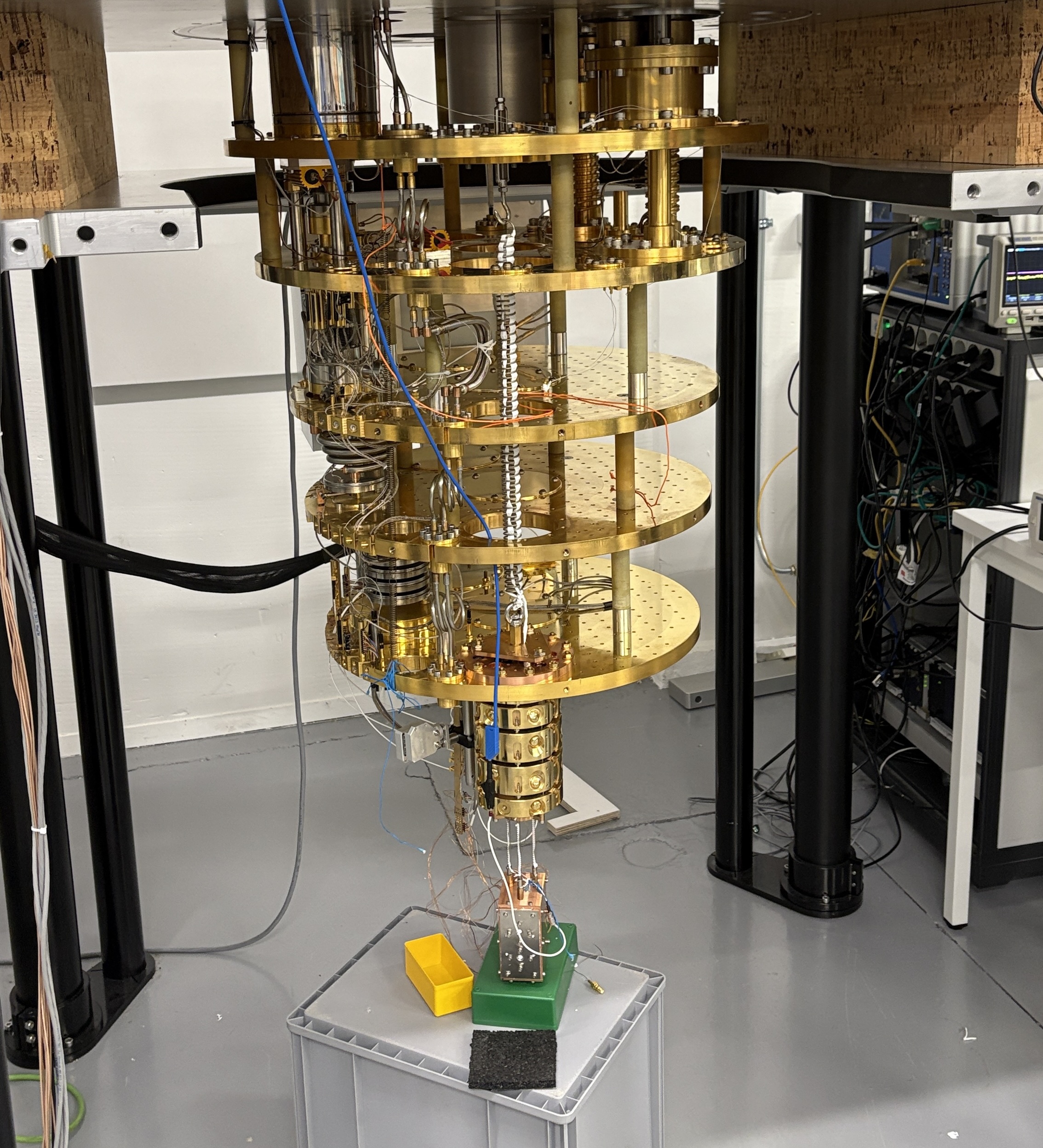
The ICVI Consortium is developing cryogenic vibration isolation for the Einstein Telescope
As part of the development of the Einstein Telescope (ET), the consortium ICVI is working on advanced cryogenic vibration isolation systems that operate at temperatures below 10 kelvin. These systems are designed to ensure that highly sensitive measurement setups remain fully protected from environmental vibrations, even under extreme cryogenic conditions.
The Einstein Telescope will be one of the most sensitive scientific instruments in the world for detecting gravitational waves: minuscule distortions of spacetime caused by cosmic events such as colliding black holes and neutron stars. To reliably detect these signals, vibrations must be virtually eliminated. This is a major challenge, as many of the necessary detector components must operate at extremely low temperatures to minimize noise.
ICVI Consortium
The ICVI consortium is led by Onnes Technologies and brings together a strong combination of research institutions and high-tech companies. Partners include JPE, Leiden University, SRON, Nikhef, Delft Circuits, Piak Electronic Design, and Magnetic Innovations. Together, they are developing a new generation of compact cryogenic vibration isolation systems specifically designed for applications requiring both extreme stability and very low temperatures.
The core of the project is the development of the world’s first compact cryogenic vibration isolation systems that remain fully stable under cryogenic conditions. The technology combines passive and active vibration damping, advanced heat conduction, and real-time feedback control. This allows for the suppression of movements that are barely controllable with existing systems.
A key component of the innovation is the cryogenic vibration damper developed by Onnes Technologies, which can isolate movements down to below 1 hertz. A smart combination of an anti-bounce mechanism and a multi-stage mass-spring system creates an exceptionally low-vibration environment in cryogenic installations, including dilution coolers that operate at temperatures of just a few milli-kelvins above absolute zero.
"The Netherlands has a rich tradition of achieving extremely low temperatures—Leiden was once known as the coldest place on Earth. This technology not only makes the Einstein Telescope possible, but is also directly applicable to quantum and semiconductor research.” - Max Kouwenhoven, CEO of Onnes Technologies
The system consists of three sequential cooling stages: from 40 Kelvin to 15 Kelvin and finally to approximately 8 Kelvin. A mechanical “kickstarter” cooler is temporarily used for rapid startup. Once the correct temperature is reached, it is switched off and the vibration-free sorption cooler takes over.
Spin-off potential — quantum technology, metrology, and semiconductors
The impact of the technology extends far beyond the Einstein Telescope. Vibration-free cryogenic environments are essential for quantum computers, quantum sensing, advanced metrology, and semiconductor instrumentation operating at the sub-nanometer scale. Applications such as cryogenic actuators and scanning probe microscopy can also benefit from the new generation of vibration isolation systems.
This development thus strengthens the Netherlands’ position in rapidly growing markets related to quantum technology and precision instrumentation. It is precisely at the intersection of cryogenics, mechatronics, and system integration that the Netherlands possesses internationally recognized expertise. This offers opportunities for new products, high-quality employment, and greater European technological autonomy.
As Kouwenhoven emphasizes: “By fostering close collaboration between research and industry, new technology can be developed more quickly for commercialization and to support new science—exactly what the Netherlands needs to strengthen its position in deep tech and quantum instrumentation.”
With ICVI, the Netherlands is not only providing a crucial technology for the Einstein Telescope but is simultaneously building a strong international position in cryogenic precision technology. This creates an innovative foundation for future breakthroughs in both fundamental research and commercial deep tech applications.
The Einstein Telescope itself is still in the planning stages. The Netherlands is collaborating with Belgium and Germany on a location in the border region. By 2027, it will be clear where the observatory will be built.
More information about the techology domain vibration damping